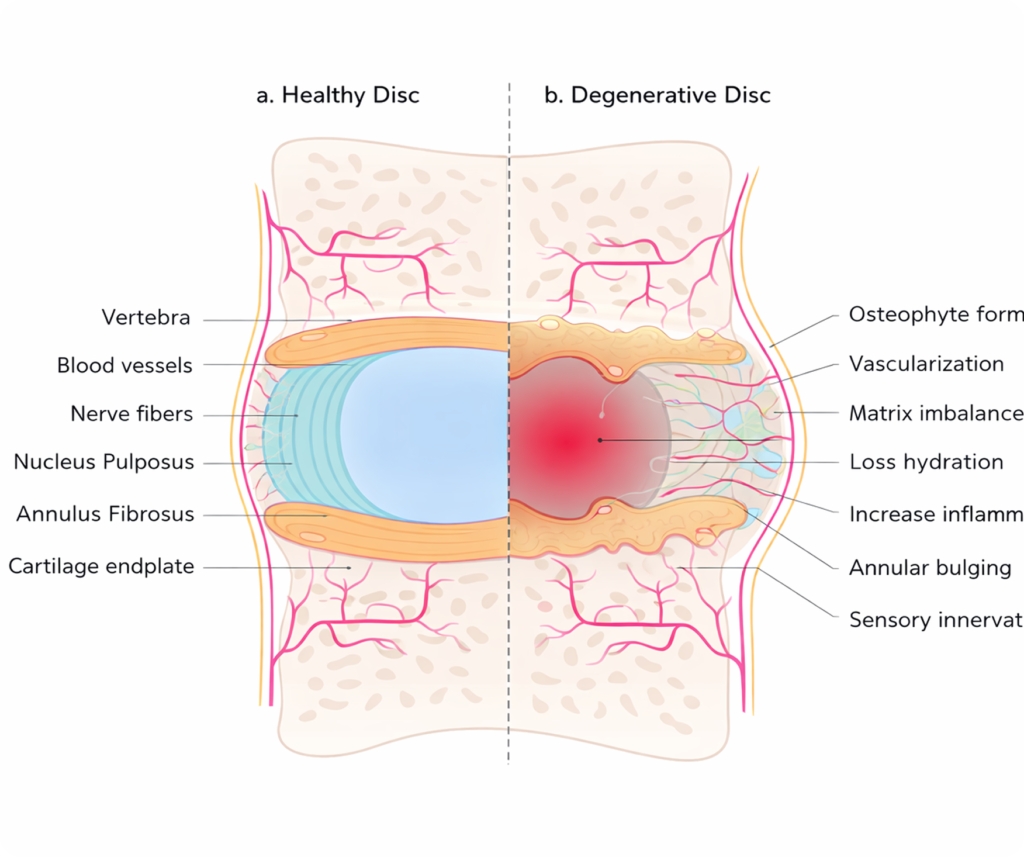
Lumbar Disc Disease

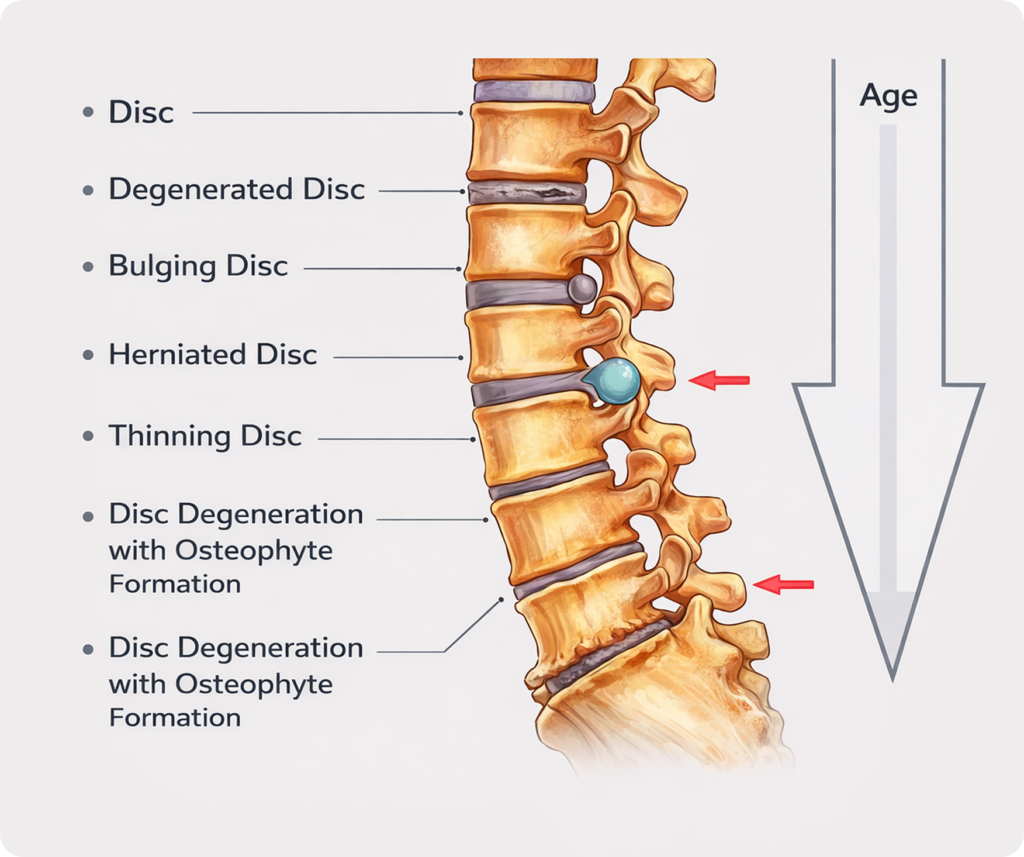
Each stage in the diagram (right) represents roughly 10 years of normal age-related degeneration. This is accelerated after injury to the disc, either gradual accumulation over time or a sudden acute traumatic event. The disc then undergoes an adaptive degenerative process to manage long term biomechanical stress and to make the injured segment stronger. This causes the segment to essentially fuse with a partial decline in flexibility and range of motion. As a result, the spine becomes a little shorter and stiffer with age due to disc degeneration and this is a normal and natural process. Symptomatically, some patients may experience lifelong discomfort, but any severe exacerbations of pain are usually temporary.

DR JUSTIN PIK

Neurosurgeon and Spine Surgeon

DR MICHAEL OW-YANG

Neurosurgeon and Spine Surgeon

Discogenic Pain

Discogenic pain arises from the sensation of increasing pressure within a disc and may start months or years before a disc protrusion. Pain is often experienced as pressure increases inside the disc until it ruptures and allows the internal pressure to reduce. Discogenic pain is typically exacerbated by long periods of standing or sitting in one position due to increased intra-discal pressure. Discogenic pain usually improves with movement or changes in position. Over years, the nucleus pulposus of the disc is gradually resorbed and the intra-discal pressure decreases. The degenerative process is therefore lifelong and gradual so treatment of symptomatic lumbar discogenic pain focuses symptom management rather than cure

PATIENT HISTORY

dull central low back pain, worse when sitting, driving, stooping or standing for long periods. episodes of exacerbation can be severe but temporary if disc material extrudes, patients may report a “pop” in the back with subsequent improvement in back pain but onset of radicular symptoms

PHYSICAL EXAMINATION

limited lumbar spine range of motion due to pain dermatomal pain, sensory loss or weakness if radiculopathy present in the worst case scenario, cauda equina syndrome may cause altered sacral sensation and lower limb weakness.

DIAGNOSTIC TESTING

X-rays can be used to exclude serious pathology such as fracture, mal-alignment or spondylolisthesis CT can identify significant disc protrusion with nerve compression but not the internal disc anatomy such as annular tear or dessication MRI is the most useful investigation for disc pathology but is only indicated in patients with nerve compression due to the high cost and low yield for any pathology requiring intervention.

Management Of Chronic Low Back Pain

Counselling—thorough and individualised counselling to reassure the patient that the pain is a normal and natural process of adaptation to injury and is a benign condition in the absence of nerve compression. Lifestyle measures—simple non-invasive measures such as lifestyle, activity and workplace modification. Maintaining a healthy lifestyle including weight management and regular exercise may reduce the progression of degenerative disc disease. Minimising aggravating factors should be encouraged such as prolonged sitting, repetitive heavy lifting, rotation and flexion of the lumbar spine. Physiotherapy treatment— the aim is to reduce pain, restore movement and function and improve mobility and strength. Core strengthening exercises are particularly important in this patient group. Analgesia—the use of simple analgesics rather than opiates is desirable to reduce the likelihood of dependency and tolerance associated with long term use. Steroid injections and denervation procedures—these minimally invasive treatments can assist with pain management over the short to medium term. Surgery is considered as a last resort if all non-conservative treatment options fail or symptoms of nerve compression are present.

When To Seek A Surgical Opinion

The main indication to refer to a surgeon is the onset of lower limb radicular pain as this indicates nerve compression. This may occur due to disc herniation and/or bony foraminal stenosis. Surgery to treat radiculopathy is highly effective – around 90% positive result – compared with surgery for mechanical low back pain without radiculopathy – around 50% positive result – when measuring patient satisfaction, pain reduction and quality of life

Our quality service to our patients and customers starts from your very first contact with our practice.

contact info
Suite 15 Level 5 National Capital Private Hospital Cnr Gilmore Crescent and Hospital Road GARRAN   ACT   2605

Copyright 2026 Capital Neurosurgery – All rights reserved.

Website designed and developed by Studio Who