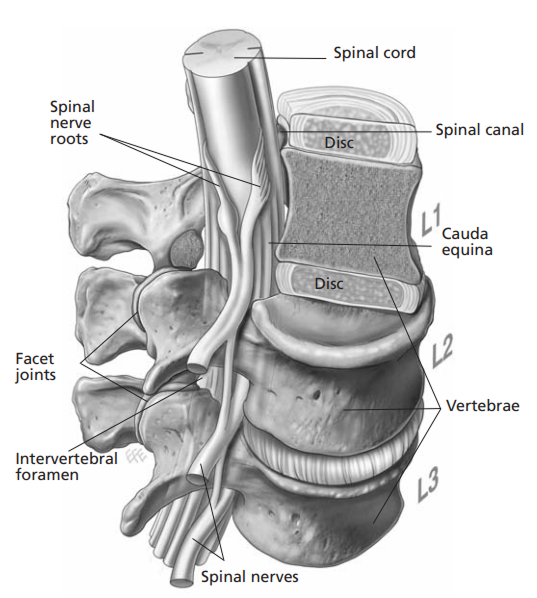
What is a Lumbar Laminectomy?
Lumbar laminectomy is a surgical procedure to relieve discomfort, cramps, pain, tingling and numbness in the buttocks or legs caused by pressure on the spinal cord, the cauda equina or spinal nerve roots. The aim of surgery is to remove the pressure by opening the spinal canal and widening it from the back. The surgeon removes bone and other tissue pressing on the affected nerves, providing more space for the nerves and reducing irritation and inflammation.
Laminectomies are typically performed to treat lumbar spinal stenosis. This is a narrowing of the spinal canal that contains the spinal cord and the spinal nerves that arise from the spinal cord, as shown in the illustration. At the lumbar level of L1, the spinal cord becomes a nerve bundle called the cauda equina.
Diagnosis
Diagnostic Imaging
Diagnostic imaging can provide your surgeon with important information about vertebrae, other spinal structures and any abnormalities. Magnetic resonance imaging (MRI), computer tomography (CT), X-ray examination and a spinal myelogram can often reveal the anatomy of the vertebrae and the precise location of any abnormalities. One or more of these tests may be necessary for accurate diagnosis. Your surgeon will examine you to determine your strength, reflexes, ability to feel pain, and ability to move. You will be asked about pain, numbness, weakness, previous similar symptoms, and any
Treatment Options